Showing posts with label Arianne Tjio | PATH. Show all posts

Sunday, August 12, 2012

Indian Airport Operations


Over the last 3 weeks, I flew 8 times through 6 airports with 3 domestic airlines for personal and work-related trips.  Due to circumstances, I usually arrived hours early for my flight and had the opportunity to observe operations at 2 major and 4 smaller airports.  While Delhi and Mumbai airports processed people much in the fashion of US and other international departure points, I found the system at the smaller airports particularly intriguing.  

Rather than continuously accepting passengers through the system, passengers are processed in batches.  When I arrived more than 1.5 hours prior to my flight, I was allowed through the first checkpoint into the airport but had to wait in a holding area prior to check-in.  Announcements were made when you could move through each step of the process:  check-in, security, and boarding.  After check-in, if your flight has not moved to the security process, you must once again wait in another holding area. 

This system works for the smaller airports because it allows them to control where passengers of a certain flight are at any given point.  It also minimizes the number of staff and parts of the airport that need to be open since flights were also clustered.  I arrived 4 hours early for my flight out of Vadodara, and the airport was all but shut down.  While I was thankfully allowed through the first checkpoint into the airport, the lights in the check-in and security areas were off with no employees in sight.  Only 1 guard was needed to ensure that passengers did not move into the check-in area.  Waiting passengers had only electric fans for cooling.  The air conditioning was only turned on when the check-in process started.  

By herding passengers of each flight through the processing system together, it also makes it simpler for the employees too.  It limited the number of destinations that check-in baggage would have to go, and with only a couple gates available, it limited the confusion of passengers of which flight was boarding.  I wonder if this system would work in a small airport in the US, e.g. White Plains-Westchester (HPN) airport, that really only has 2 gates and passengers in the single, large waiting area are always confused as to which flight is being boarded at which gate, resulting to passengers attempting to get on the wrong flight.  
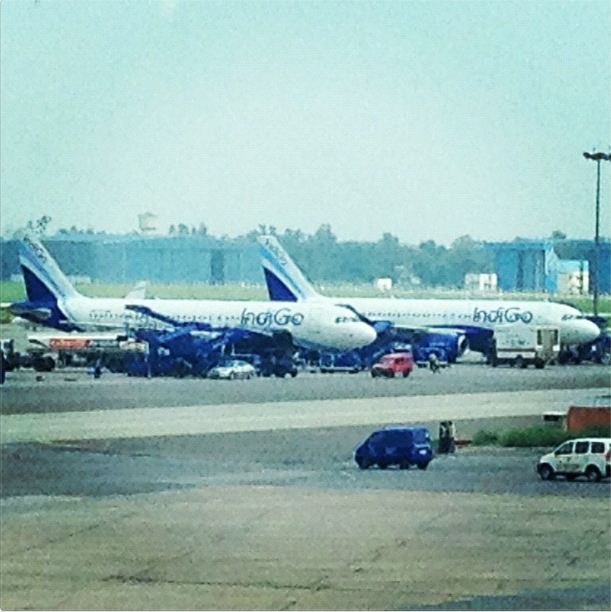

At the Delhi and Mumbai airports, I also appreciated the busing system.  Instead of building a large structure with concourses and individual gates, domestic passengers boarded buses that took them to planes that parked away from the main terminal.  As the passengers were bussed in batches, it allowed the passengers from each bus to settle in their seats before the next bus came, rather than continuously adding passengers into the system causing the backup in the jetways that normally happens on US domestic flights.  Thankfully, I haven’t experienced this system in the rain – I imagine that it becomes much more chaotic and wet during a downpour.  
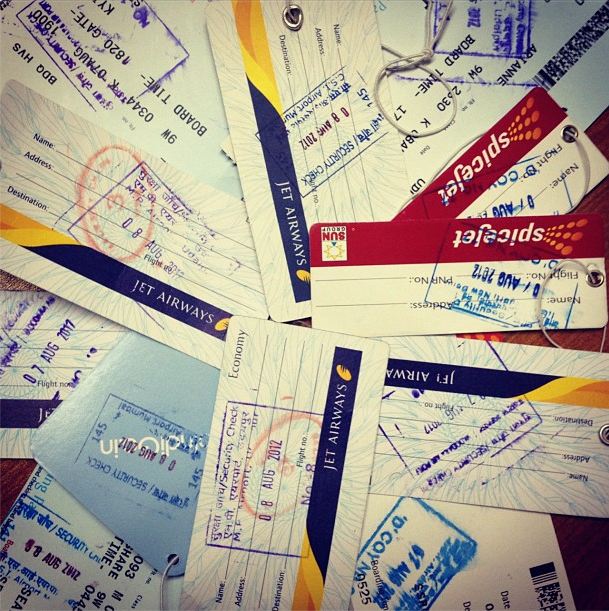
One thing that I do think that India Airport Authority should look into is minimizing the amount of paper used.  For each flight, I needed a printed itinerary in order to be let into the airport at all.  If you did not have one, you could pay for one to be printed at the ticketing office.  No e-itineraries on a mobile phone were accepted.  In addition to the physical boarding pass issued (no mobile boarding issued because security has to stamp it), each carry-on item has to have a tag which gets stamped by security.  After my recent whirlwind tour of Gujarat and Rajasthan, I amassed a lot of paper that had to be thrown away.  While I'm sure India will come on board with accepting e-boarding passes and such soon, US airports should take a look at the operations at their Indian counterparts as well. 

Wednesday, July 11, 2012

Delhi Heat


Hallelujah, the heat streak in Delhi has broken!  At least the 100+ temperatures.  With the monsoon season coming, temperatures have dropped, but humidity has risen.  However, I am finding it much more bearable to be outdoors now.

During the month of June though, stepping outside felt like walking into an oven.  I know I am extremely fortunate to be living in an air conditioned room, get driven to work in an air conditioned car, and work in an air conditioned office.  Though ironically, when it is extremely hot out and everyone has their air conditioning on, it strains the power grid and we frequently lose electricity.  After my first week, I too became unfazed as the lights and other electronics flickered on and off, not letting it interrupt conversations. 

I did try to sightsee some in Delhi in the heat, though you could probably tell I was a bit heat weary.  At Humayun’s Tomb, Jen Hsieh and I would rest in the shaded areas or in the wonderfully cool chambers tomb before preparing ourselves to venture into the hot sun again.  We carried bottles of water, but by the end of our time at the tomb (which wasn’t long at all), the water was actually hot – not just warm, but near scalding hot.  So we skedaddled to the nearest ice cream trolley outside of the gates for some cool, refreshing mango bar.  Only 5 rupees – score!


Walking in the Delhi heat, I frequently saw stray dogs lying in the roads, on the sidewalks, or even in piles of trash.  I would try to see if their chests were moving - if they were still alive - but it was often hard to tell.  It was only because they were there day in and day out that I assumed they were still alive and just overwhelmed by the heat as well.  It saddened me to see how these stray dogs must be suffering under the harsh sun, mostly skin and bones.  Their only fault is to have been born on the streets.  After mentioning this to a friend from Delhi, he had this to say which both made me laugh and gave me comfort:
Don't feel too sorry for stray dogs, at least not all of them. Many of them are ruffians, they form packs and make merry at night barking and running around the neighbourhood, chasing cars and motorcycles. Many of them are quite happy doing this hooliganism. They get waste food from restaurants and compassionate people. Rich and poor - all types of people - take care of these dogs; you will notice that many security guards adopt and take care of these dogs and give them company at night. There are animal care hospital trusts which take care of hurt stray dogs (and cows, goats, cats, donkeys). My mother also takes care of 6-7 stray dogs in our neighbourhood (vaccinations, medical aid when they get hurt etc.) And there are many more like her. Even in slums, you'll see that these dogs know who is compassionate and hang around those houses where they are taken care of. There is no organized care but many of them get along on the basis of individual human kindness and compassion. So there is another side to the story.
Thank you, friend, for reminding me that there are dimensions at play that I do not see or cannot assume to know; that I cannot make judgments based upon the preconceived notions I bring with me.

Friday, July 6, 2012

When did giving become so complicated?


We’ve all seen those pictures of Indian children in tattered clothing on the streets begging for money or food from passing cars and pedestrians.  It breaks my heart every time I see them.  There is a particular intersection on my way home from work where they swarm the cars as the light turns red, peering sadly into the windows trying to catch my eye.  Once they do, they start pleading in Hindi.  Even though I do not understand the words, I know what they are asking for.  My first instinct is of course to want to give them something, but then other thoughts flood into my head.  If I give one child something, will she share it with the others or will she keep it for herself and gloat about it?  Or will the larger boy bully her into him my offering?  Or is she, like in Slumdog Millionaire, a beggar working for gangsters?  What is my social responsibility?  In my desire to do some good, would I actually cause more harm than good?  How do I weight the negative versus the positive impacts?  Conflicted into inaction, I bow down my head and avoid their gazes.  The light turns green, my car speeds away, and I breathe a sigh of sadness. 

Sad that something as simple as giving a little bit of money to someone on the street has become so complicated.  Has it always been so or have I only now been clued in to the different dynamics at play?  I remember as a child, walking down the streets of Hong Kong holding my mom’s hand, where homeless men sitting along sidewalks were not an uncommon sight.  Those on the routes we took frequently became landmarks for me, as they seemed to always be in the same spot, reassuring me that we were on the right track.  Once in a while, my mother will press a coin or bill into my hand and nudge me towards one of them.  Giving a shy smile, I would drop the donation into his bowl.  In those innocent acts as a child, did I accidently cause a rifts between the homeless men?  Did I perpetuate his panhandling “job” because he made more money this way than with a real job?

When did giving become so complicated?

(I apologize for the lack of pictures in this post.  You need only to google “Indian street children” to see what I see.  Taking pictures of the specific ones along my route for the purposes of this blog just felt wrong.)

Wednesday, June 13, 2012

Banking Liquid Gold


Passionate.  That’s how I would describe the folks that I met at PATH’s headquarters in Seattle.  Perhaps it’s because I arrived the week of the Breakfast for Global Health, PATH’s largest local annual fundraiser, and everyone had their stories rehearsed.  But I don’t think so.  The passion with which people spoke about their projects was palpable.  Number of lives improved.  Number of lives saved!

It is with this enthusiasm that I am diving into my project on milk banking.  What is a milk bank, you ask?  It’s like a blood bank, but for breast milk.  It is a facility that processes milk donated by mothers with excess milk to be used by an infant in need, often in the Neonatal ICU.  Weird, you say?  Well, it’s really wet nursing taken to the next level and that is a practice that many of our ancestors employed.  Modern-day milk banks screen donors for things like disease, lifestyle habits, and medications; pasteurizes the milk to kill viruses (including HIV) while keeping the beneficial parts of the breast milk mostly intact; and tests for any bacterial growth. 

Why all this hoopla over breast milk?  If you guessed that as part of the evolution process, a mother’s milk has evolved to provide many things that her baby needs nutritionally and immunologically, then you’re right!  In fact, it has been shown that infants who are not breastfed have a 6 fold greater risk of dying from infectious diseases in the first 2 months of life than those who are breastfed (WHO Collaborative Study Team, Lancet, 2000).  6 fold!!  To put it in business terms, Brazil estimates that it saves US$540 million each year, mostly due to reduced medical costs.  It's no wonder that it has been termed "liquid gold" by some.  Sadly, due to the marketing efforts of formula giants like Nestle, infant formula has replaced breast milk in many places since it is viewed as an aspirational product that is better than or at least equal to breast milk. 

Back to milk banks – who do they help?  Sometimes, momma can’t feed baby, at least not just yet.  In premature births, a mother sometimes has trouble starting lactation.  It can also help those who are low-birth weight, severely malnourished, orphaned, born to HIV positive mothers or mothers who are otherwise not able to breast feed.  As you can imagine, the number of babies that fall into this category can be quite high in developing countries.

Thus, this summer I’ll be conducting an in-depth country assessment of the market opportunity for milk banking in India and to identify areas in which PATH can accelerate the expansion and adoption of human milk banks.  In India, WHO estimates 48 out of every 1000 babies born die within their first year of birth.  India also reports a high percentage of babies with low-birth weight, low weight-to-height and low height-to-age ratios.  I look forward to trapezing all over the country to learn more about milk banks as well as the culture, and at the end hopefully be able to bring insights and innovation to milk banking!  Lives saved!  (and because I am in business school) Costs avoided!