Showing posts with label Dan Bickley | Ihangane project. Show all posts

Sunday, August 12, 2012

Cultural Exchange

As you can tell from all of my previous posts, I've been having a great time in Rwanda for the last 10 weeks.  It’s been a real adventure, and I've learned a lot about Rwandan culture along the way.  Between going to weddings, attending church services, being surrounded by the local music and a new language, and eating nothing but Rwandan food, I've been totally immersed.  And because I've enjoyed my time with my friends here so much, I've been trying to give a little something back.

American culture is, as in much of the world, pretty pervasive here.  Lots of our music and movies are exported to East Africa, and most of the young people here seem to know a lot more about our celebrities than I do.  And although many of the same singers and actors are idolized in both countries, I can’t help but feel that Reality TV shows, Snoop Dogg, and even Celine Dion (who continues to be massively popular here, for some reason) don’t really represent the American culture that I know.  Sure, those figures are a part of our American culture (never mind that Celine Dion is Canadian), but they’re small parts that are overrepresented here, with the effect that my Rwandan friends only know about those aspects.

Football!
So I decided to share a little bit of the culture that they don’t get exposed to here.  And what is more American than football and bacon?  Luckily I had a few old Michigan football games saved on my hard drive (you never know when they’ll come in handy!), so I asked around and found that there was a ton of interest in seeing them.  Once I showed a few people, I got even more requests.  I think the entire village is hooked on American football now – I must have watched the same three games four or five times a piece over the course of the summer!
Thanks, Mr. Butcher!

The bacon idea was a little trickier.  Rwandan food is mostly based on potatoes, bananas, beans, and assorted vegetables.  Occasionally you’ll see some beef, but I hadn’t eaten any pork since I’d been here.  So I had to make a trip down to the village center on market day to pay a visit to the local butcher.  Each butcher usually kills one animal per day, and unfortunately the first shop I stopped by was slaughtering a cow.  But as luck would have it, the guy next door was about to prepare a pig, so I quickly put in my bid for the belly.  It took a little explaining, since the animals here aren’t really divided into cuts of meat like in the US, but rather just cut apart and sold by weight.  But after some gesticulating and pantomiming, I ended up with 7 pounds of pork belly, ready to be cooked.

Excited about eating a pig
With 7 pounds of meat, I had enough to make two meals.  So I began with a pork belly roast even though it wasn’t part of my original plan.  I managed to scrounge up some salt, sugar, and vinegar to marinate it, and aside from the oven not being hot enough to crisp up the skin, it turned out pretty well!  Meat isn’t roasted here, but is usually just cut into small chunks and sautéed, so it was a new experience for my Rwandan family.  But after that meal, my thoughts returned to bacon.  I decided to cure the remaining pork belly with the same salt/sugar mixture, and I added some local honey as well to make a sweeter bacon.  I searched for days for black pepper to complete the mixture, but nobody in the village had ever heard of it.  I was lucky again though, and managed to find a mostly empty bottle of ground pepper at kitchen of the local church.  With the final ingredient in hand, I combined everything in the fridge and waited a week. 
Something Resembling an American Breakfast


Everyone Loves American Food!
In the end, I couldn’t set up a smoker to put the finishing touches on the mean, so we had to settle for green bacon.  But with a few added accoutrements in the form of hash browns, scrambled eggs, and pancakes, it proved to be quite a success!  


If I’ve accomplished nothing else this summer, I’ve definitely converted some of my friends here into lovers of bacon and football.  And that, I think, is what cultural exchange is really all about.

Monday, July 30, 2012

Learning to Relate

It hardly seems like it, but I’ve now finished 2 out of 3 months of this fellowship, and it’s definitely been busy!  In the last few weeks, I’ve wrapped up the first assignment – the analysis of information flow between different levels of Rwandan health care – and made some recommendations about how to improve the way that patients move between health centers and hospitals and better ways to manage information.  And in the process, I’ve been learning a lot about how to manage different types of working relationships.

I had the chance to pitch my ideas to some of the key hospital administrators, and the conversation ended up as a spirited debate.  In the end, many of my recommendations were accepted, but a couple weren’t.  Coming from a medical background, I found this to be a little bit of an unusual situation.  Sure, there are patients labeled as “noncompliant”, but in medicine –especially in a tertiary care hospital setting like the University of Michigan – patients listen to their doctor’s advice more often than not.  But here, the relationship is very much unlike the patient-doctor interaction I’ve grown used to.  There were good arguments on both sides, to be sure, but in the end this is the Rwandan system, and it must reflect the values of those who work in it every day.  It’s been an interesting change of pace to help build capacity in this system and let go of an idea sometimes, rather than to diagnose and treat in a specific, standardized way.    

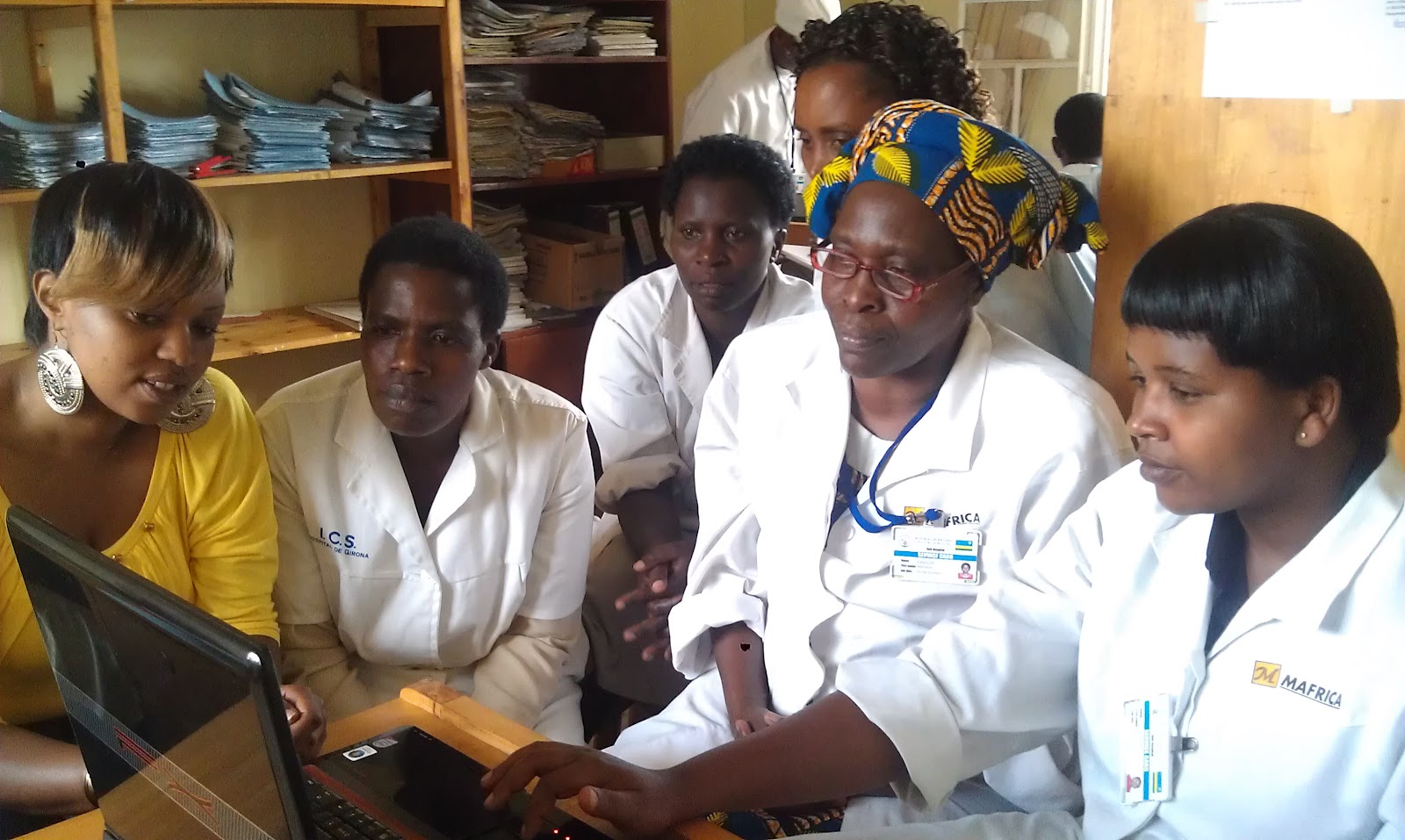
Since getting the in-principal approval of the recommendations I’ve been working on laying the groundwork to switch over.  One of the key recommendations that this spring’s MAP team made, and I’ve modified somewhat, is the implementation of an electronic registration and appointment system to replace the laborious paper version that is currently being used.  So to begin the transition, my translator Delphine and I have been giving computer lessons for the better part of the last month and learning about the student-teacher relationship in the process.  We began well ahead of our expected implementation date, and I’m glad we did; we’ve needed every minute!  We’re training a group of employees who work around the registration system, none of whom had ever used a computer before.  And it has been slow going.

I knew I would have to do some computer training going in, but the total lack of experience on the students’ end has proven to be a really interesting and unexpected challenge.  In retrospect, I suppose it was to be expected, but I think it speaks to the nature of our totally technologically integrated society that I hadn’t consciously considered that the employees here wouldn’t have a minimum level of experience with computers.  So I’ve had to learn rather quickly how to impart a skill that comes so naturally to me, but that my pupils have absolutely no frame of reference for.

I tried to start at the very beginning and go as slow as possible.  The whole first session was devoted to turning a laptop on and moving the cursor through the touchpad.  Even the simplest function was totally alien to them, and it’s been a challenging daily exercise for the better part of a month now.  Yet at the same time, these women have made enormous progress.  Yes, we’re still working on double-clicking and using scroll bars, but they’re getting more and more functional each day.  And most importantly, they’ve been incredibly enthusiastic and willing to try new things the entire time we’ve been working together.  And I think I've learned as much from our time together as they have!  Patience, time, and the eagerness to learn are the key factors that I’ve taken away from this experience that will help me to be both a better teacher and student in the future.

Our class in session
We’ve made enough progress that we’re looking at piloting the new system this week.  Within the next couple days, we should have an idea of how well this is going to work in practice, and we can begin troubleshooting the inevitable unforeseen problems.  But for now, I’m just excited to see how the culmination of the work so far looks in action!

Wednesday, July 18, 2012

Getting A Little Culture

I’m at the halfway point in my internship here in Rwanda.  6 weeks down, 6 weeks left to go!  A 12-week project sounds like it will last a long time, but now that I realize that I’ve only got 30 working days left to implement and iron out the bugs in a new system, it seems a little more like I’m working against the clock.  So lately I’ve been focused mainly on the work of teasing out which changes in structure might benefit patients and health care providers at Ruli Hospital and its outlying health centers.  But even so, I’ve been making time to explore the land of a thousand hills a little bit and experience Rwandan culture.
A fine dowry indeed!

I've had a couple notable experiences so far, the first of which was having the distinct pleasure of attending a Rwandan wedding.  One of the younger doctors from Ruli Hospital was tying the knot with one of the other workers there, and they invited me to the ceremony, which was conveniently being held not more than a 3 minute walk from my adopted home.  At first, I was a bit hesitant.  I hadn’t known the couple very long and I certainly didn’t want to intrude on a private, intimate event.  But they wouldn’t take no for an answer, and escorted by the more senior doctors and their families, I made my way to the event.  And what an event it was!  Starting at 8 in the morning, I walked over to the outdoor ceremony at the bride’s home which began the day.  As soon as I entered the yard I was quickly ushered in front of the nearly 200 other guests, where I had the opportunity to see a public negotiation over the dowry – for 4 hours! 

The happy couple
After a brief recess, the attendees moved up the road to the local church, where a religious ceremony was held and the couple formally married.  After a longer rest (time for a nap!), everyone reconvened in a large hall nearby for a reception.  I attempted to hide in the back this time, but I was quickly identified and dragged front and center.  The evening was similar to a wedding reception in the US, complete with dinner, drinking, and of course, dancing.  Around 8 PM, the crowd began to disperse, and I began to walk home, carefully on the dirt road, in the pitch black night.  But before I could get there, I was pulled aside to go to the after party!  This turned out to be the intimate gathering I had imagined, with a crowd of only 20 or so at the home of the new couple.  But after the whole day of ceremonies and ritual, I was welcomed warmly and was able to watch the couple’s family members come bearing a traditional gift of home furnishings and supplies to last for the first 3 months of their new life.  All in all, a special experience that I won’t soon forget.


But not all of my time here has been spent among the Rwandan people.  The wildlife deserves some attention too!  One visit that I made a point to make was to Akagera National Park.  The park is in the East of the country, bordering Tanzania, and its geography is totally different than the plentiful hills and valleys prevalent through most of the country.  In the East, the peaks slowly change into smaller rolling hills which give way to a flat grassland.  There, antelopes, zebras, hippos, giraffes, and many other animals make their home.  I had good company for the trip too – Sean Morris, the Ihangane Project intern and WDI fellow from last year, accompanied me on an adventure through the Northern half of the park.  We saw a good variety of African wildlife from the safety of the car, but we were able to get out and walk around as well.  Standing in the middle of the savannah among a herd of giraffes was an amazing feeling! 
Current and former WDI fellows, plus a few giraffes!
Opportunities like these have made this internship a unique one.  The work is truly meaningful and interesting, and these “extracurricular” experiences are icing on the cake.  I can’t wait to see what adventures await me in the second half of this summer! 

Sunday, July 1, 2012

Once more, with pictures!


Hello again!  I'm checking in after a busy first month here in Rwanda, and everything is going well so far!  As I detailed in my last post, I've been working on learning about the way that the health care system works here, and how people exchange information to treat patients.  It's been an interesting process so far to learn a new system, meet dozens of new faces, and get out and about in the villages surrounding my home base of Ruli.

I spent the first week or two just getting used to the hospital, and learning my way around the system.  Ruli Hospital is a district hospital, the middle ground between the primary-care oriented health centers and the specialized referral hospitals in the capital, Kigali.  It's a busy place, averaging 40-60 outpatient visits daily, and performing around 60 surgeries, delivering close to 100 babies, and giving hundreds of vaccinations each month.  In addition, it offers physical therapy, dentistry, and ophthalmology services to the local population.  With all these resources and people in one place, it's a complicated machine.  For my first weeks at the hospital I found myself in a constant deluge of introductions and welcomes, and I was struggling just to keep up.  Simply remembering everyone's name and where they fit into the hospital system was a small victory in itself! 

Since then, I've gotten to know a number of people fairly well.  Though there are too many to list them all here, there is one who deserves special mention.  My partner in this project is Delphine, a Ruli native with great ideas and vision for our work.  In addition to lending her mental faculties to The Ihangane Project, she serves as a phenomenal translator and source of cultural understanding.  To top it off, she's finishing school to become a radiographer, and this experience allows her to come up with insights into the Rwandan medical system that a newcomer like me would take months or years to think of.  With her help, we've been able to make the most of our time here so far!


After taking time to acclimatize to the hospital environment, we have spent a few days traveling to some of the health centers that refer patients to Ruli Hospital.  We're spending most of our time in the village of Nyange, as this is where we hope to begin using the information that we're gathering about information and patient flow to create a tangible product: improvements to the referral system between health centers and the hospital. 

Once or twice a week, we have been making the trip to Nyange to build relationships there and gauge the best way to improve this process of communication.  The roads in Rwanda aren't the best.  In fact, in many cases, they are really “roads” only in the loosest sense of the word – and the road to Nange is particularly bad.  The village is only about 10km away, but it takes between an hour and 90 minutes to go each way.  Although I'm sure it will all be worth it in the end, the fact remains that four rides per week in this rough terrain takes a certain toll on a traveler's tailbone!

And so for now, I must go to nurse my injured coccyx and spend some time analyzing the heaps of data we've been collecting.  I'll be back in a week or two, internet-permitting, of course, with more East African updates!

Monday, June 18, 2012

Muraho Rwanda!


Murakaza neza! - Welcome to my blog, where I will be updating with news from my project here in Ruli, Rwanda. Like most of my WDI colleagues, I'll be working on a project in the field for the next 12 weeks. In my case, I'll be working with a district hospital and network of health centers to try to understand the complex chain of information flowing between clinicians and administrators and between different levels of the Rwandan health care system.

But first, a little background. I'm working with The Ihangane Project, a non-profit organization dedicated to making sustainable improvements in the lives of Rwandans through community-based projects in nutrition, sustainable energy, economic development, and patient-centered health care. As part of its continuing mission, in March and April of 2012, The Ihangane Project sponsored a team of students from the Ross School of Business to study ways to improve the flow and usage of data at Ruli District Hospital.
This summer, I will be building upon the base of analysis they have provided, and extending the scope to consider the flow of information and patients in the larger context of the hospital and a number of its affiliated health centers in the surrounding villages. In understanding the “big picture”, we will be able to characterize specific processes – the path of diagnosis and treatment of diabetes, or malnutrition, for example – and will be able to make recommendations and implement improvements that are congruent with and sustainable within the existing health care system.
I've been on the ground for about two weeks now, and have gotten off to a great start on the project. At the same time, I've also experienced a warm initiation into Rwandan culture. Everyone has been remarkably welcoming; the faces in Ruli are always friendly and everyone makes time to stop and chat. My skills in the native language, Kinyarwanda, are rapidly improving from dozens of these informal lessons each day. From sampling brochette, (the delicious local goat kebabs), to participating in 5-hour-long church services (at least 3 hours of which seem to be devoted to dancing), I'm learning a lot about how this community works and what makes it special. I already know that this will be a great summer living in Ruli, learning, and working for better delivery of health care in this amazing part of the world. I'll be posting here with updates and insights through the rest of the project, but for now, murabeho – goodbye until next time!