Showing posts with label adapting. Show all posts

Tuesday, July 31, 2012

adaptation

India comfort food
We humans are pretty unique in our adaptability. We adapt to new environments, situations, circumstances, and ideas with relative ease (well, most of us, anyway). We can handle a lot, and change makes us physically and mentally stronger.

So why do so many of us shy away from situations where we might test that ability? We have such a powerful tendency to shroud ourselves in comforts and shut out those opportunities that would challenge us. Even those who intentionally push ourselves naturally gravitate back toward a status quo. Change is hard, change is painful, change is scary. Newness can pierce us to the very core, threatening to upend all that we have learned about ourselves and our world.

Close your eyes and picture the house you grew up in. Walk yourself through the front door, to the kitchen, bathroom, your bedroom. Mental models stick with us long after we require them. There's a theory that humans developed the ability to create mental models of their surroundings in our earliest phases. By lending an element of predictability to harsh and dangerous environments, mental models allowed us to survive. 

But mental models can also be limiting and constricting. In the U.S., we create predictability that spills into monotony. We expect what we know, and are upset when we don't find it. We rely on our mental models and material possessions to keep us safe and block out uncertainty. We relish the control given us by the ease of foresight. Close your eyes and picture the nearest highway interchange. Walk yourself from Applebees to Walmart, Subway, Shell. Now picture the interchange five miles down the road. If you're in the Midwest you might get a Dairy Queen, the West Coast an In&Out Burger, but the scenery is essentially identical.

a major part of my Bombay mental model

I have built simple mental models of the neighborhoods I've stayed in throughout India and the basic layout of Mumbai. But it's impossible to apply them elsewhere, and they're in constant flux. My days are unpredictable, my material comforts in limited supply. The change has been hard, painful, and scary. But my need for that level of control and possession has receded somewhere, and been replaced by peace and acceptance. I feel lighter, stripped of some amount of unnecessary artificiality.

That internal lesson - that you truly can live with less, and it might even be more comfortable that way - is one of the huge benefits of traveling and living abroad. I know that tendency toward self-protection will slowly settle back over me when I return to the States, but I'll ward it off as long as possible.
---

[Note: I originally intended this to be a post about climate change, but wandered pretty far off target! Main bullet points: I found out that this is caused by this, and also this is happening, which links back to this. I had a closer along the lines of: "How far can we reasonably expect ourselves to adapt?"]

Friday, July 13, 2012

Learning a new trick or two

“There are no foreign lands. It is the traveler only who is foreign.” ~ Robert Louis Stevenson

“A traveler without observation is a bird without wings.” ~ Molish Eddin Saadi

One of the best parts about traveling is learning the ins and outs of a new culture. At first, everything feels foreign. The first few weeks I asked myself, “Why do they do things that way?” or “Wouldn’t it be better if they did things differently?” It was all part of the assimilation process. Now that I’ve adapted (mostly) to the new culture and shed some of my American habits, I am able to accept the differences that Indian culture offer. In fact, I think America could learn a thing or two from India. Here are a few that come to mind:

1. Low paper towel usage. I have been impressed, and admittedly sometimes annoyed, that Indians seem to use few paper products. Restrooms rarely have paper towels with which to our dry hands, paper napkins are hardly ever present at restaurants, and toilet paper is not used (they have a whole water system that isn’t my favorite, but does the trick). The lack of paper use may be a cost issue, but whatever the cause it has a great effect. Think about how much paper we waste in the states! Paper cups, paper plates, paper towels, paper napkins, paper, paper, paper. It’s not like paper grows on trees… oh wait, it does, and that’s the problem. We need to be more mindful of how we use our resources. 

2. Energy efficient light switch designs. One of my favorite things about India is their sockets. Every socket has a corresponding switch so you can turn off whatever is plugged into it. This is great for so-called “vampire loads,” a fancy term for appliances that use energy even when they’re turned off. Plugs are also designed to fit multiple types of plugs so you don’t have to find the right adapter. Just plug and play! Pretty geeky I know, but pretty cool. Again, we need to be more mindful of how we use our resources and energy is one of the big ones!
3. Easy to use door handles. Not everyone I work with agrees with this, but I love their door handle design. Instead of a door handle that twists, you simply press down on a button with your thumb and the door opens. I’m not sure if door handles in the states cause carpal tunnel or can exacerbate arthritis, but this design would solve those problems!
4. Speedy (and cheap!) auto rickshaws. India is flooded with small, light, fuel efficient vehicles (at least the 4-stroke engine ones) that are essentially directable public transportation. They’re like cabs, but they’re cheaper, more fun, and easily accessible. They’re more expensive than buses, but then you don’t have to deal with a crowd of people. A friend of mind believes that, “a fleet of autos that could charge half the price of taxis would make a killing in NYC or other taxi-heavy cities” and I agree. Great business idea!
5. Pollution reducing driving habits. Indian drivers are taught that if they sit at a light for longer than three minutes that they should turn their engine off. I’m sure there’s an argument that the practice slowly degrades the car’s battery or ruins its engine, but it also helps to reduce air pollution. Which would you rather have: a slowly degrading car or slowly degrading lungs? Pretty easy decision I think (says the asthmatic).

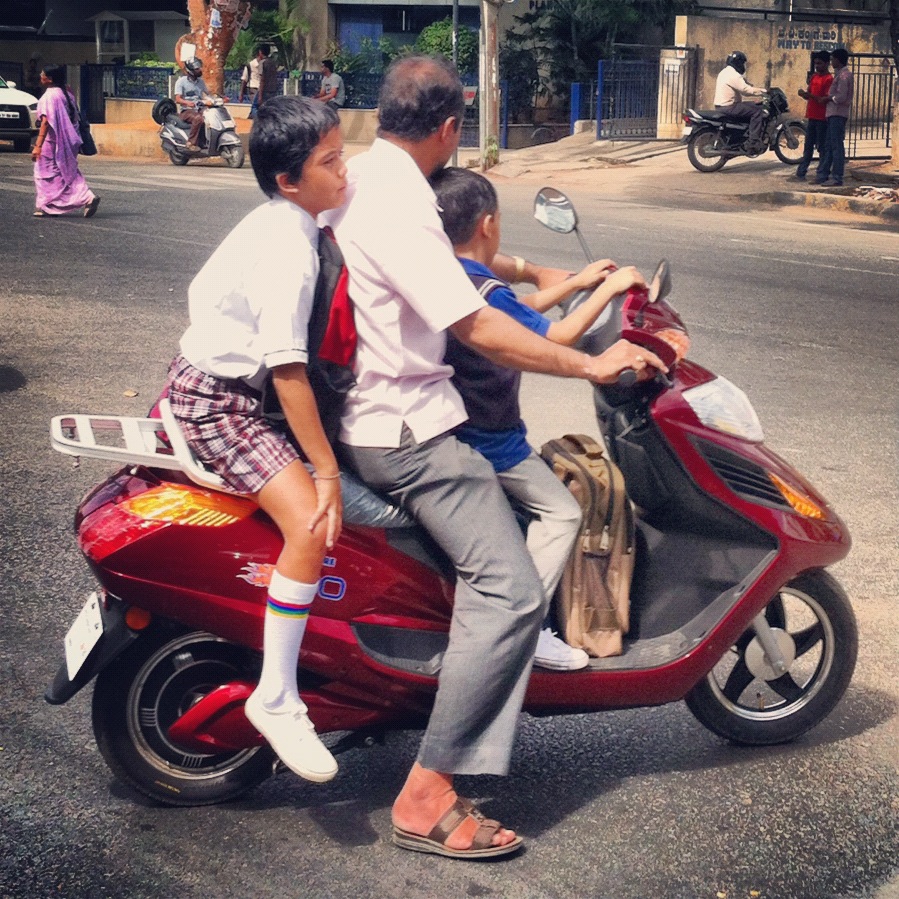
6. Smaller family vehicles. You’d be surprised how many people can fit on a moped. It is very common to see a family of three or four driving on a small moped: Pop driving, one kid in front of him, mom riding behind with one more kid stuffed between mom and pop. I once saw a family of five do this and there are rumors of someone having seen a family of six! They’re a little like great white sharks though, coveted but rare to see. This practice calls into question the American “need” for SUVs or mini-mans. And if anyone argues that American families need the space to get out of the heat, try telling that to the moped family living in India where the summers can get as hot as 120 degrees Fahrenheit. 
It’s easy to come to a new culture and see all of things that you would change to make it more like home. It is far more difficult to see things in a new culture that you would want to adopt in your own. It requires an admission that my culture can be improved and, in this case, the humbling proposition that the very developed country I call home can learn something from a developing country. But I subscribe to the idea that new and better ideas can sometimes come from the unlikeliest of places and that just because something is “the way it is” doesn’t mean it’s the best way to do it. After all, America was a developing country once and we turned out just fine.

What technology, behavior, or philosophy have you seen that you think the Western world should adopt or could learn from? Post your responses below. Come on, don't be shy!