Showing posts with label India. Show all posts

Friday, September 7, 2012

Social Enterprises: The "Silver Bullet"?


As I mentioned in my previous post, I have been deciding what to share in my final post. Should I talk about culture in India? My personal adventures throughout this vast and diverse country? My life in the most cosmopolitan and populous city in India?

I could speak about my experiences but because I know I'm coming back soon (or at least to another emerging market), I've decided to share what I've learned from early-stage social entrepreneurs in India which  is far more interesting... well ,for me at least! So what have I learned?

Focus on doing one thing well: Early-stage entrepreneurs usually have limited resources to get their product or service to market and start gathering feedback and generating revenue.  Entrepreneurs have a choice: do many things poorly or focus on doing one thing (or a few things) well. From my conversations, the entrepreneurs that choose to focus on one thing tend to have a more coherent pitch, vision and plan of action to achieve the vision. As a MBA student, this lesson hits home even more. In business school, you are inundated with opportunities - professionally, socially, and academically. Would you rather attend that corporate presentation tonight, study for an upcoming exam, attend a social event for your favorite club, or go to a happy hour with your friends? Logistically, you can't do everything. Fortunately, what you decide underlies that which you value most thereby (hopefully) leading to a more defined focus.

Understand who your customers are and listen to them often: Rather than try to sell to everyone at once, entrepreneurs are more likely to succeed if they take the time to first understand who to sell to and work to meet their needs. Entrepreneurs that pay attention to their customers, peers, and even competitors have a much higher chance of survival. For example, during my conversation with Chachii, the co-founder had identified peers in India and abroad to better understand their models. With this analysis, the entrepreneur further differentiated her service while identifying potential exit opportunities. Another common thought among entrepreneurs is that "if you build it, they will come" which is especially prevalent for entrepreneurs with a technically superior product. Although your product or service may be the next best thing, the ultimate judge for any entrepreneur should be the market and their customers. Numerous cases, such as Betamax vs VHS or the more recent Blu-Ray vs HD DVD, demonstrate that business success hinges less on your amazing and technologically advanced product specifications than on your ability to listen to your customers and execute on your model.

Focus on business model first, social impact second: Without a viable business model, any social impact that a social entrepreneur generates is short-lived (note: my definition of a social enterprise is one that seeks financial and social/environmental returns.) Although understanding the context of the social or environmental issue that an entrepreneur is trying to address, the immediate questions that come to mind all relate to an entrepreneur's business model including:
"Have you identified a market with customers who have some willingness to pay?",
"How do you plan to offer your product or service cost-effectively to eventually generate profits?", and
"What or who stands in your way and how do you plan to address that?"
For social entrepreneurs, the last question is one of the toughest since achieving social impact usually involves changing behavior and these enterprises face the toughest competitor: the status quo with customers who are usually resistant to change regardless of how the product or service could "change their lives". For example, solar lamps and cookstoves provide a safer and cleaner alternative than kerosene as light or fuel for cooking, respectively. Plenty of entrepreneurs sell these but few have managed to convince potential customers to switch, differentiate themselves and achieve scale.

Play well with others: Besides overcoming the status quo, social entrepreneurs occupy a unique space as they usually try to offer something that the government has failed to do (or at least, do well), non-profit organizations provide free or at cost like water or food, incumbents "offer" usually in the form of exploitation, or any combination of the three. Social entrepreneurs need to understand if, when, and how to engage with these players to create a market with fewer distortions thereby leading to sustainable and long-term change. For example, NextDrop has worked with the local water utility from day one because without the utility's buy-in (agreement), NextDrop would not have been able to launch its SMS service.

A market-based approach is not the end all be all for poverty alleviation or any other socio-economic or environmental issue. Humanitarian aid to countries or regions in conflict or post-major natural disaster, for example, is the most feasible solution despite its shortcomings and criticism. At the same time, my experiences with social enterprises and non-profits have convinced me that social enterprises have the potential to address most socio-economic issues. They, however, need to closely collaborate with government and the social sector to adequately address the complex, inter-related nature of these issues. Market-based approaches and especially social enterprises are not the "silver bullet". But they should lead the way to achieve real and sustainable social change.

Thursday, August 30, 2012

Do social impact metrics matter?

“Social ventures can use logic models to communicate their effectiveness to investors and funders, and to identify how to improve their impact, all without collecting a single measure.”
-MaRS white paper: Social Entrepreneurship (Social Impact Metrics), 2010

“Arguably the biggest obstacle to the creation of social capital markets is the lack of a common measure of how much good has been done: there is no agreed unit of social impact that mirrors profit in traditional capital markets.”
- The Economist, September 2009

Impact investing and social enterprise are the current darlings of the business world. Differentiated from Darwinian capitalism by their focus on making the world a better place while generating a financial return, these emerging industries have enormous potential to create dramatic change - if they can believably, quantitatively prove themselves.

But social impact metrics aren’t cut and dry like financial metrics. They’re messy. They’re difficult to define: how do you quantify increased quality of life? They’re difficult to collect: who do you talk to, what numbers do you need? And they’re difficult to interpret: do higher test scores really mean better schools? Do better schools lead to increased income, equality, and happiness? Are people telling you the truth, or telling you what they assume you want to hear? Social impact metrics require substantial investment of time, energy, and resources. But without them, how can you be sure you’re making a difference?

Completing summer internships with a social enterprise and an impact investor, Mary Fritz (Erb Institute for Global Sustainable Enterprise, MBA/MS ‘13) and Patrick Huang (Ross School of Business MBA ‘13) have experienced the complexity of this question firsthand. They discuss their thoughts in the conversation below.

Patrick: Could you briefly share what you're doing with Wello in India?

Mary: Wello addresses clean water access problems in rural areas by improving personal transportation methods through our innovative tool, the WaterWheel. We are structured as a hybrid social enterprise, comprised of a for-profit and non-profit arm. Most activities to this point have been conducted under the non-profit umbrella; my overarching goal is preparng Wello for capital investment to engage the for-profit side.This has involved creating a pricing structure, financial modeling and scenario planning, and developing our market entry strategy (including identifying robust, meaningful impact metrics and a means of collecting the necessary data). 

And what are you doing for Village Capital in India?

Patrick: My main mandate is on pipeline generation, i.e. identifying and shortlisting enterprises for two upcoming Village Capital programs in India. In brief, VilCap organizes 12-week business accelerator programs for early-stage social enterprises. VilCap’s main differentiator is our intensive peer-review approach in which the cohort not only provides honest feedback to each other but also decides which two receives pre-committed financing. In the past 3 years, we have organized 14 programs by partnering with organizations such as the Hub, Dasra Social Impact, and the Unreasonable Institute.

To start off, I wanted to quickly draw a contrast between traditional, commercial enterprises and “social enterprises.” Commercial start-ups collect standardized financial measures like revenue and costs to understand their own financial situation and success, to plan for the future, and to share with external users like investors. For-profit social enterprises do the same (by committing the time and resources), but they also grapple with the additional quantifying their social impact. Is that what a social start-up should focus on right away?

Mary: It’s tough for a start-up to devote the resources necessary to collect and interpret meaningful data around impact. You need people on the ground, in the field, to constantly monitor change, and you also need people to respond to those inputs from a strategic level. It’s been my experience that most investors would rather see those resources put toward building and scaling the core business. So it’s a matter of comparing the value of metrics with the value and opportunity costs of spending your resources there. What do you think, Patrick?

Patrick: I agree, especially for early-stage enterprises like the ones that I have spoken with. The main priority for entrepreneurs in the early stages should focus on defining a financially sustainable and viable business model. Without this, any social returns generated will be short-lived.

Since these enterprises are usually started by one or two founders with seed funding from friends and family, entrepreneurs need to allocate any capital and resources to the core business and operations. With this initial capital, entrepreneurs can develop a prototype or proof-of-concept and test this out through a small-scale trial run or pilot. Through this process, entrepreneurs start to define and refine their business model. All of these activities are critical for a business to build a business, social-oriented or otherwise.

Mary: Exactly. At Wello, we’re building our impact data collection into our business model pilot. People “get” our intended outcome, but the type of customers we hope to attract will need us to prove it. So essentially, the business model relies on accurate social impact data.

Patrick: I get that. Any true social entrepreneur (whether he or she self-identifies as one) will always remain cognizant of the enterprise’s social impact and ideally, that impact would be “baked into” the model itself. As another example, I’ve spoken to a couple of entrepreneurs that design and implement renewable-powered micro-grids that provide access to energy to households in remote, off-grid areas in India. These entrepreneurs have a business model that provides a key service (energy) to households and generates revenue for the enterprise while creating social impact through energy access. At the same time, these entrepreneurs track the number of households served as a necessary metric for both their operations and social impact.

Mary: So does tracking the number of households served equate to social impact?

Patrick: Not necessarily, although in the case of access to energy, I would argue that renewable energy has a strong correlation to positive social returns such as better health (by eliminating the use of kerosene) to increased income and better education (by providing light to shop owners to sell their wares and children to continue studying). However, these social returns are much more difficult to define, collect, track, and manage for an early-stage entrepreneur who is still struggling with keeping her business running while staying true to her initial mission for social change. I still maintain that entrepreneurs at the early stages have much higher priorities to focus on.

On the other hand, I would argue that tracking and managing social metrics is not only viable but necessary for growing social enterprises that have the resources and capital to scale, especially those that are financed by impact investors. These enterprises have already received financing from traditional commercial investors or impact investors and both the entrepreneurs and investors should support the allocation of resources to do so. Based on my conversations with people from Grassroots Business Fund and Acumen Fund, both impact investors that focus on supporting social enterprises in the growth stages, they have developed initial approaches to track the social impact of their invested enterprises but neither of them are perfect.

Mary: I worked with Acumen Fund for MAP. We were tasked with researching successful exits in some target sectors and evaluating potential pipeline deals. Trying to expand our limited selection of examples, we stretched our definition of social impact (e.g., does PayPal have a social impact because it gives people access to digital transactions without credit?). Because the social enterprise space is so young and holding times are lengthening, it was tough to find relevant example deals. But they pushed us hard to prove a legitimate social mission and impact. If Acumen Fund can’t collect metrics from its portfolio companies, how can it measure its own impact? Without metrics, how do you evaluate potential investments?

Patrick: I can relate to your and Acumen’s struggle with identifying “social enterprises”. Identifying a social enterprise requires a commitment to a market-based business model and social impact. During my internship, some questions that I may ask entrepreneurs include “Who are your target customers or Who do you serve?,” "What area(s) do you serve - urban, rural, something in between?,” "Who are your major clients to date (large corporations or individual households)?,” “Who do you employ [for enterprises that work in rural areas)?" Based on the answers to these questions, I can better determine whether an enterprise is socially oriented or not. In addition, as a SvF Fellow at Ross during my first year, I tackled these same issues as a member of the Health Investment Circle. There was an assumption that any enterprise in health would be socially-oriented. At a high level, this is probably true but the same type of questioning is still relevant. For example, if an enterprise targets wealthier customers or those with more means than other customers, that enterprise would probably not pass our social impact screen.

Mary: That’s largely what I’ve seen, and I wonder if Acumen Fund and Grassroots Business Fund are exceptions to the rule? Several investors I’ve spoken with this summer have explicitly told me that impact metrics aren’t necessary; they just want to see the financial return. Financial return is necessary to build a sustainable business (and thus maximize impact), but this approach bleeds pretty heavily into traditional VC.

The other problem with that more general approach is that it doesn’t force you to critically evaluate your true impact on the populations you aim to serve. Are you accomplishing your mission? Do your achievements reflect your intentions? Are there negative impacts to your activities? There’s a difference between a socially oriented organization and one that produces a true social return on investment.

From the entrepreneur’s perspective, there are also some pretty compelling reasons to collect metrics early on. As I mentioned, sometimes business depends on it. For example, Wello expects larger orders to come from institutional customers such as government, NGOs, and CSR departments at MNCs. These customers are all impact-focused, and to attract them, Wello will need to demonstrate quantitative proof of concept. We will have a much easier time appealing to a wider range of stakeholders when we can quantify our impact. And we want to ensure that we’re adhering to our mission and actually accomplishing what we’ve set out to do - before scaling.

Patrick, how credible do you think metrics can be? How much insight do investors have into the meaning behind the numbers? How do you ensure your cash is really making an impact?

Patrick: Credibility for social impact metrics is largely determined by how accurately we can quantify the impact at an absolute and relative level. The time when we can quantify social impact metrics at the same level as we do for financial metrics, however, is probably a ways off. For example, on education, how does selling books to children compare to building schools? On health, how does providing telemedicine services to remote, rural communities compare to building low-cost primary health clinics in low-income areas? If one is better than the other, how much better? Now, what if we were talking about a rural community in New York and a low-income area in the war-stricken Congo or vice versa? The answer to these questions are difficult as they tend to define the value on a person’s life. Despite the adage “a person’s life is priceless,” people are already quantifying life. If we don’t quantify a person’s life whether that person is a teenage girl in rural Afghanistan or a wealthy person in upstate New York, then someone else will do it and that number may ultimately be zero.

Mary: There has been some pretty public criticism of impact investing recently - complaints that SVC is ill-defined and has failed to distinguish itself from traditional VC, etc. Do you think social metrics could help legitimize the industry?

Patrick: Definitely. There are many critical next steps for the industry to take such as supporting enterprises to reach scale that would inevitably demonstrate a viable track record for the impact investing industry as a whole. Defining reliable and standardized impact metrics is another important first step to start an open and transparent discussion as to whether a commercial business model that seeks both financial and social returns is even viable in the first place.

Mary: I agree. People naturally want to believe in social enterprise and impact investing, especially as traditional business and hardcore capitalism are increasingly vilified. They're such nice stories - do good and make money. But meaningful metrics are the only way of solidifying that theoretical link between social and financial returns. And those metrics have to be standardized and applicable across social businesses, so collaboration is necessary. It will be really interesting to watch all of this unfold over the next few years.

Patrick: Do the needful, kindly revert.

Mary: Great answer. I think we’re done here.


Sunday, August 12, 2012

Indian Airport Operations


Over the last 3 weeks, I flew 8 times through 6 airports with 3 domestic airlines for personal and work-related trips.  Due to circumstances, I usually arrived hours early for my flight and had the opportunity to observe operations at 2 major and 4 smaller airports.  While Delhi and Mumbai airports processed people much in the fashion of US and other international departure points, I found the system at the smaller airports particularly intriguing.  

Rather than continuously accepting passengers through the system, passengers are processed in batches.  When I arrived more than 1.5 hours prior to my flight, I was allowed through the first checkpoint into the airport but had to wait in a holding area prior to check-in.  Announcements were made when you could move through each step of the process:  check-in, security, and boarding.  After check-in, if your flight has not moved to the security process, you must once again wait in another holding area. 

This system works for the smaller airports because it allows them to control where passengers of a certain flight are at any given point.  It also minimizes the number of staff and parts of the airport that need to be open since flights were also clustered.  I arrived 4 hours early for my flight out of Vadodara, and the airport was all but shut down.  While I was thankfully allowed through the first checkpoint into the airport, the lights in the check-in and security areas were off with no employees in sight.  Only 1 guard was needed to ensure that passengers did not move into the check-in area.  Waiting passengers had only electric fans for cooling.  The air conditioning was only turned on when the check-in process started.  

By herding passengers of each flight through the processing system together, it also makes it simpler for the employees too.  It limited the number of destinations that check-in baggage would have to go, and with only a couple gates available, it limited the confusion of passengers of which flight was boarding.  I wonder if this system would work in a small airport in the US, e.g. White Plains-Westchester (HPN) airport, that really only has 2 gates and passengers in the single, large waiting area are always confused as to which flight is being boarded at which gate, resulting to passengers attempting to get on the wrong flight.  


At the Delhi and Mumbai airports, I also appreciated the busing system.  Instead of building a large structure with concourses and individual gates, domestic passengers boarded buses that took them to planes that parked away from the main terminal.  As the passengers were bussed in batches, it allowed the passengers from each bus to settle in their seats before the next bus came, rather than continuously adding passengers into the system causing the backup in the jetways that normally happens on US domestic flights.  Thankfully, I haven’t experienced this system in the rain – I imagine that it becomes much more chaotic and wet during a downpour.  

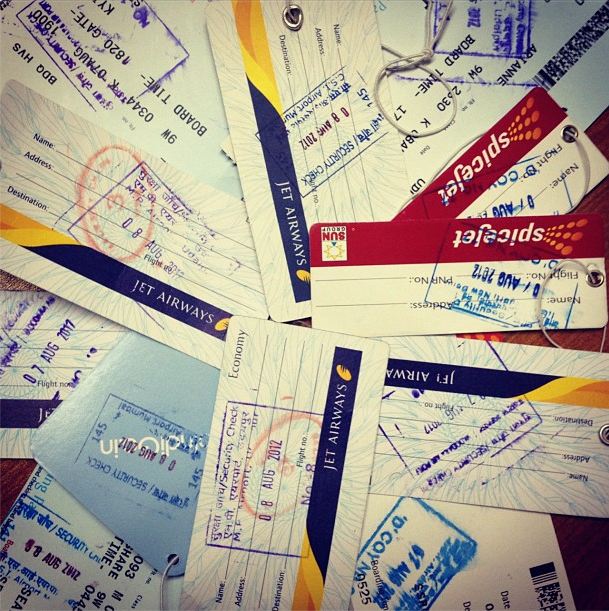
One thing that I do think that India Airport Authority should look into is minimizing the amount of paper used.  For each flight, I needed a printed itinerary in order to be let into the airport at all.  If you did not have one, you could pay for one to be printed at the ticketing office.  No e-itineraries on a mobile phone were accepted.  In addition to the physical boarding pass issued (no mobile boarding issued because security has to stamp it), each carry-on item has to have a tag which gets stamped by security.  After my recent whirlwind tour of Gujarat and Rajasthan, I amassed a lot of paper that had to be thrown away.  While I'm sure India will come on board with accepting e-boarding passes and such soon, US airports should take a look at the operations at their Indian counterparts as well. 

Tuesday, August 7, 2012

What inspires you?

As I was pondering what to write in what is likely my last blog post, I was looking for inspiration: inspiration to write something meaningful, worthwhile and educational for the wonderful people who have been following this blog.

Should I write about the monsoon season and how Delhiites look forward to the rains because it means relief from the 100+ degree Fahrenheit weather? Should I write about the power outage that affected 600 million people (twice the population of the entire United States!) in northern India? Should I write more about life in India and how while there is a divide between the rich and poor, they are able to reside in the same neighborhoods? Or, should I write about finishing my internship deliverables, which included operational process maps, organizational structures, compensation structures, defined job roles and HR overviews?

Inspiration can be different for many people. It could be spiritual, emotional, or practical. For my client, she prefers the principals and teachers to be inspired enough to want to send their students on heritage walks and incorporate heritage education into the schools’ curriculums. She doesn’t try to push them just to increase her numbers. She wants them to feel that there’s a need for heritage education. She wants her “customers” to try it out and see for themselves.

As I am now in my last week in India and at Start Up!, just like there is much to see and do in India but not enough weekends to explore every place, there is much to share but hard to describe it all on paper/blog. There is so much happening in India in the social impact space. Many of us have posted pictures to provide a glimpse into the social sector and life in India, and as the saying goes, "A picture is worth a thousand words." However, sometimes, you just got to come and see for yourself to be inspired.

India: You’ve been good to me these past 13 weeks. I will miss the curiosity, breadth of ideas, convenience of auto rickshaws, home delivery for pretty much everything, house help, reclining seats at the movie theaters, and of course the many Indian and non-Indian cuisines (especially the Chinese food). Thanks for hosting me and look forward to future visits to see the power of inspiration at work!
Glimpse through Amber Fort in Jaipur

Glimpse through the Taj Mahal

Friday, August 3, 2012

Alls Well That Ends Well

“The whole object of travel is not to set foot on foreign land; it is at last to set foot on one’s own country as a foreign land.” ~ G.K. Chesterton

Today is my last day in India. In a few hours I board a plane that will take me home. As when I arrived, I leave with mixed emotions: happy to head to the comfort of my familiar life in Michigan, sad to leave new friends, recent adventures, and the opportunity to continue exploring the vastness of India. I have been here for just 10 short weeks – in the scheme of things nothing more than a blink of an eye – but they have been a great 10 weeks that will have a profound effect on how I see the world. If past is truly prologue, then I know that some of the ways I’ve changed won’t reveal themselves to me for a few months and even a few years. Still, I’ve learned some new things along the way, challenged some old beliefs, and gained some new perspectives. Here are a few that come to mind:

I take a lot of things for granted. This experience has shown me that what we become depends in large part on where we start. My life has been shaped by forces that were in motion before I was born and have nothing to do with my choice, my interests, or my natural-born abilities. Much of what I have and much of the opportunities I have been fortunate enough to take advantage of were available to me because I was born a white male to two middle-class parents in one of the richest countries on earth. Don’t mistake me. I’m not saying this is wrong or unfair or bad. I'm not saying that I haven't worked hard or benefited from that work. But to deny that there was a strong foundation built for me upon which I worked is to deny simple fact. For example, at home I don’t obsess on a daily basis about clean water, hygienic food, or deadly diseases. Our advanced infrastructure allows me, instead, to obsess about other things, like when the next Rolling Stones album comes out, what the plot of the next Batman movie will be, or what to write for my next next blog post. India is on the road to matching our largesse, but I can’t help but wonder which is better. Either way, I hope I don’t forget how luxurious my life is in the states.

Electricity shaped my life. Think for a second about how important electricity is in your life. Think about all of the ways you use it: it powers every appliance in your house – your fridge, TV, washing machine, dryer, coffee machine (or espresso machine if you’re cool like that), and microwave. It fuels your gadgets, both the sedentary (desktop computer, wine chiller, etc.) and portable (smart phone, laptop, notebook, Kindle, etc.). Electricity supports your productivity and is the great enabler of your procrastination. It allows you to enjoy movies, milkshakes, and malls. Like me, you may not have realized how much you owe electricity for your personal, social, cultural, and professional development. It has helped you become you. Now, imagine that you grew up in a world without electricity. Who would you have become?

I love start-ups. I knew I loved start-ups already, but this summer helped cement the feeling. Simpa has been a great place to work. I’ve learned some great new skills (data tables! Internal rate of return calculations!), met some fantastic people, worked on challenging projects, slept on the couch for a few weeks, and got to impact a fast-growing start-up poised to change the world. It has only fueled my hunger to start my own company. Now all I need is a good idea…

 
Traveling is better with friends. I’ve traveled near and far in India and seen some incredible sites. On each trip I’ve had the pleasure of traveling with friends. Fortunately, I get to see most of them again in a few weeks. The others I plan to keep in touch with.


Life is boring without a challenge. I came to India for a lot of reasons, but the main reasons were the same ones that have driven me my entire adult life: to challenge myself to try new things, experience life by living it, and constantly work to gain new knowledge, meet new people, and try new experiences. The goal, of course, is to constantly renew myself. Living in India, being separated 8,000 miles from friends and family, and working for an early-stage start-up have all been, to borrow an Indian phrase, a maximum challenge. And I have loved every minute. I wouldn't give any of it up (well, maybe a day or two of diarrhea). It has been a fantastic journey filled with amazing sights, sounds, and people. 

One of my favorite quotes is, “What we obtain too lightly, we esteem too cheaply; ‘tis dearness only that gives everything its value.” If that is true, then my summer in India is as dear and as invaluable to me as any experience I’ve had so far. And that’s saying something. 


Thursday, August 2, 2012

countdown

It's cliche, but I seriously can't believe I'm about to leave India already. I've settled in and made a little home here. I have routines, I've learned the ropes, I've learned some Hindi, and I feel like India can't do much that will shock me anymore. Now that I'm comfortable, I'll uproot myself and head 'home.' On the other hand, I'm pretty sure I got here just yesterday. The summer has flown.

In celebration of all things India, I've been keeping some lists:

Numbers
wtf.
  • Elephants: 7
    • 3 working (Bombay, Jaipur)
    • 1 trumpeting (Jodhpur)
    • 2 hanging out eating leaves (Kerala)
    • And 1 named Akbar, that I paid 100 Rs to pet adoringly (Kerala)
  • Monkeys: 8 (until I lost track in Kerala)
  • Times asked to be a Bollywood extra: 2
  • Times asked to take a photo with strangers: 13
  • Times asked to take a photo for strangers: 0
  • Photos "sneaked" of me: countless
  • Edible Arrangements: 1
  • Party Rock Anthem: 1
  • Starbucks: 0
  • Camels: 21 in one day, then I lost count (Ahmedabad + Rajasthan are camel central)
  • Broken dinosaur sculptures: 6
  • Peacocks: I lost count after one jumped at me in Jaipur. Rajasthan is the place to go for peacocks.
  • Cats mating: 2 pair
Favorites

  • Favorite bumper sticker: "Watch out - I STOP at red lights"
  • Favorite way of being asked if I need to use the toilet: "Urine?"
  • Favorite reassurance when the entire bus windshield shatters all over us, and after a quick dusting off we continue windshieldless at 100+ kmph, in the dark, in the monsoon: "Don't feel uncomfortable."
  • Favorite brand rip off: tied between "Google Denim" and "Facebook Restaurant"
  • Favorite sign advertising a police station: "Better late than never."
  • Favorite roadside warning: "When care dies, accident happens."
  • Favorite men's underwear ad: "Style to negotiate a complete surrender." [See 'women' post...]
Recommendations
  • Mumbai
    • Restaurants: Yoga House, Cafe Britannia, The Village, Suzette, Bagel Shop, Fellas, Caravan Serai (but be clear that you are ordering a full chicken, not four chickens.)
    • Shopping: Anokhi, Play Clan
    • Activities: Colaba art galleries, walking along Marine Drive, riding the train, strolling the neighborhoods
  • Ahmedabad
    • Restaurants: Swati Snacks, Green House
    • they say...
    • Highlights: Ghandhi everything
  • Jaipur
    • Restaurants: Haveli
    • Highlights: peacocks, elephants, Amber Fort
  • Jodhpur
    • Restaurants: Omelette shop
    • Shopping: all over the old city
    • Highlights: walking around the old city, Mehrangah Fort, jeeping out all over Rajasthan to meet with rural communities
  • Kerala
    • Restaurants: just have your meals cooked by the houseboat crew
    • Highlights: Munnar climate, houseboating
Things I'm looking forward to
  • Showering without a bucket
  • Sleeping without DEET
  • 6 craft beers for the price of one Hoegaarden
Things I'm not looking foward to
  • My cell phone
  • Lack of papaya
  • Lack of Yoga House
  • That other kind of stress

Tuesday, July 31, 2012

adaptation

India comfort food
We humans are pretty unique in our adaptability. We adapt to new environments, situations, circumstances, and ideas with relative ease (well, most of us, anyway). We can handle a lot, and change makes us physically and mentally stronger.

So why do so many of us shy away from situations where we might test that ability? We have such a powerful tendency to shroud ourselves in comforts and shut out those opportunities that would challenge us. Even those who intentionally push ourselves naturally gravitate back toward a status quo. Change is hard, change is painful, change is scary. Newness can pierce us to the very core, threatening to upend all that we have learned about ourselves and our world.

Close your eyes and picture the house you grew up in. Walk yourself through the front door, to the kitchen, bathroom, your bedroom. Mental models stick with us long after we require them. There's a theory that humans developed the ability to create mental models of their surroundings in our earliest phases. By lending an element of predictability to harsh and dangerous environments, mental models allowed us to survive. 

But mental models can also be limiting and constricting. In the U.S., we create predictability that spills into monotony. We expect what we know, and are upset when we don't find it. We rely on our mental models and material possessions to keep us safe and block out uncertainty. We relish the control given us by the ease of foresight. Close your eyes and picture the nearest highway interchange. Walk yourself from Applebees to Walmart, Subway, Shell. Now picture the interchange five miles down the road. If you're in the Midwest you might get a Dairy Queen, the West Coast an In&Out Burger, but the scenery is essentially identical.

a major part of my Bombay mental model

I have built simple mental models of the neighborhoods I've stayed in throughout India and the basic layout of Mumbai. But it's impossible to apply them elsewhere, and they're in constant flux. My days are unpredictable, my material comforts in limited supply. The change has been hard, painful, and scary. But my need for that level of control and possession has receded somewhere, and been replaced by peace and acceptance. I feel lighter, stripped of some amount of unnecessary artificiality.

That internal lesson - that you truly can live with less, and it might even be more comfortable that way - is one of the huge benefits of traveling and living abroad. I know that tendency toward self-protection will slowly settle back over me when I return to the States, but I'll ward it off as long as possible.
---

[Note: I originally intended this to be a post about climate change, but wandered pretty far off target! Main bullet points: I found out that this is caused by this, and also this is happening, which links back to this. I had a closer along the lines of: "How far can we reasonably expect ourselves to adapt?"]

Wednesday, July 25, 2012

Social entrepreneur profile: Aneesh Khanna, MyLabYogi


What is MyLabYogi? MyLabYogi is an online platform that enables patients the freedom to book and complete a diagnostic test at their convenience. Aneesh, a MBA with years of diagnostics industry experience, founded MyLabYogi earlier this year and the start-up has already completed hundreds of transactions.

How does MyLabYogi work? Patients schedule a diagnostic test, with or without a doctor's prescription, online. After choosing a lab for the results to be processed, the patient pays online or chooses to pay cash on delivery. Similar to Chachii, MyLabYogi is ahead of the curve on e-commerce / online payments as cash transactions is still common. After the patient chooses to complete the test at home or at the workplace, a trained staff member collects and transports the sample to the designated lab. After the lab has processed the sample, the patient receives the results online.

Why is this important? Currently, doctors prescribe diagnostic tests for patients and refer them to specific laboratories to complete the test. Unfortunately, these laboratories are open during normal working hours and are usually busy. Patients could spend hours waiting to complete a diagnostic test. In addition, doctors usually receive kickbacks from these laboratories thereby further inconveniencing patients. MyLabYogi shifts the power dynamic to the patient, empowering them to choose when and where they would like to complete their diagnostic tests at a comparable cost with exceptional quality. In addition, MyLabYogi has invested in creating a positive customer experience (a rarity in India) to drive repeat business. Despite entrenched interests from doctors, MyLabYogi has successfully partnered with top laboratories who stand to gain additional revenue by reaching additional customers.

What is the impact on society? A decent percentage of MyLabYogi's customers are chronic patients or those who are immobile and have difficulty traveling to laboratories. For these customers, MyLabYogi offers convenience without sacrificing quality. Other customers are professionals who work long hours (the normal working hours here is around 10am - 8pm or later) and usually can't take a half or full day off work to go to a lab.

What is MyLabYogi's vision? MyLabYogi plans to expand into other healthcare and diagnostic services as well as the major metropolitan cities in India. With more than 15000 people per day conducting diagnostic tests in Mumbai alone, MyLabYogi wants to capture more of the market before expanding to other major cities.

The next time that you need to get a lab test (and you happen to be in Mumbai), check out MyLabYogi

Thursday, July 19, 2012

Social Entrepreneur Profile: Tanvi Surti, Chachii


How time flies! I'm more than half-way done with my VilCap internship in Mumbai and I'm excited to report that I've made considerable progress. My main mandate for the summer was to generate a pipeline of interested social enterprises that fit our upcoming VilCap business accelerator programs. Despite this extremely broad and challenging goal, I have fully embraced my entrepreneurial spirit by speaking with more than 100 people, 75% of those are entrepreneurs while the others are associated with institutions  supporting entrepreneurs like incubators.

The sector focus for the entrepreneurs I've spoken to range from energy access and education to health and handicrafts. Each one of them has no shortage of passion and dedication to advance their enterprise while positively impacting millions. Supporting these entrepreneurs is why I am pursuing a career in impact investing in emerging markets.

Every entrepreneur is amazing in his or her own right so I have decided to showcase a few social entrepreneurs for my remaining blog posts. The first entrepreneur is Tanvi Surti with Chachii.

What is Chachii? Chachii is a SMS and online-based platform that connects laborers such as maids and drivers to people who need short-term, temporary help. Tanvi Surti, a recent graduate at Bryn Mawr College, is one of the co-founders of Chachii. After completing college, she decided to move back to India to start Chachii in Mumbai, India.

How does Chachii work? Individuals post tasks online or by phone and Chachii selects a laborer that can complete the task. After receiving information about the laborer, the individual sits back while his or her task is completed. After the task is completed, the laborer pays the pre-determined amount (no haggling!) to the individual while Chachii takes a small cut of the payment. Although e-commerce is still fairly new in India, Chachii is paving the way by encouraging online transactions and payments with online pre-paid credits.

Why is Chachii important? In Mumbai and across India, hiring help like a driver for your car and a maid for your flat is extremely common especially for people in the middle class and higher. Given that Mumbaikars are more liberal and progressive, more bachelor(ette)s in Mumbai live on their own compared to those in other more traditional cities. Although hiring a driver or maid is still common for these customers, they usually cannot afford a full-time driver or live-in maid. Hiring short-term, temporary help is much more appealing. Finding good-quality, reliable, and trustworthy help is difficult though as most people use personal networks and references. Much like Angie's List and Task Rabbit based in the states, Chachii fills this gap by connecting laborers while encouraging customer feedback to increase transparency and drive repeat users.

What is Chachii's impact on society? In India, most laborers come from lower-income groups usually those at the upper edge of the Base of the Pyramid. Chachii connects people from these groups as well as college students looking for extra income. By joining the Chachii network, laborers have the potential to make a sizable monthly income in addition to their full-time work.

What is Chachii's vision? Besides expanding the range of services offered, Chachii hopes to expand to all major metropolitan cities in India and reach an estimated 60 million laborers in the unskilled and informal labor market across India. With its current focus on Mumbai, the most populous city in India, Chachii has its work cut out for them!

To learn more about Chachii, you can view an interview with Tanvi and check out the site.

Wednesday, July 11, 2012

Delhi Heat


Hallelujah, the heat streak in Delhi has broken!  At least the 100+ temperatures.  With the monsoon season coming, temperatures have dropped, but humidity has risen.  However, I am finding it much more bearable to be outdoors now.

During the month of June though, stepping outside felt like walking into an oven.  I know I am extremely fortunate to be living in an air conditioned room, get driven to work in an air conditioned car, and work in an air conditioned office.  Though ironically, when it is extremely hot out and everyone has their air conditioning on, it strains the power grid and we frequently lose electricity.  After my first week, I too became unfazed as the lights and other electronics flickered on and off, not letting it interrupt conversations. 

I did try to sightsee some in Delhi in the heat, though you could probably tell I was a bit heat weary.  At Humayun’s Tomb, Jen Hsieh and I would rest in the shaded areas or in the wonderfully cool chambers tomb before preparing ourselves to venture into the hot sun again.  We carried bottles of water, but by the end of our time at the tomb (which wasn’t long at all), the water was actually hot – not just warm, but near scalding hot.  So we skedaddled to the nearest ice cream trolley outside of the gates for some cool, refreshing mango bar.  Only 5 rupees – score!


Walking in the Delhi heat, I frequently saw stray dogs lying in the roads, on the sidewalks, or even in piles of trash.  I would try to see if their chests were moving - if they were still alive - but it was often hard to tell.  It was only because they were there day in and day out that I assumed they were still alive and just overwhelmed by the heat as well.  It saddened me to see how these stray dogs must be suffering under the harsh sun, mostly skin and bones.  Their only fault is to have been born on the streets.  After mentioning this to a friend from Delhi, he had this to say which both made me laugh and gave me comfort:
Don't feel too sorry for stray dogs, at least not all of them. Many of them are ruffians, they form packs and make merry at night barking and running around the neighbourhood, chasing cars and motorcycles. Many of them are quite happy doing this hooliganism. They get waste food from restaurants and compassionate people. Rich and poor - all types of people - take care of these dogs; you will notice that many security guards adopt and take care of these dogs and give them company at night. There are animal care hospital trusts which take care of hurt stray dogs (and cows, goats, cats, donkeys). My mother also takes care of 6-7 stray dogs in our neighbourhood (vaccinations, medical aid when they get hurt etc.) And there are many more like her. Even in slums, you'll see that these dogs know who is compassionate and hang around those houses where they are taken care of. There is no organized care but many of them get along on the basis of individual human kindness and compassion. So there is another side to the story.
Thank you, friend, for reminding me that there are dimensions at play that I do not see or cannot assume to know; that I cannot make judgments based upon the preconceived notions I bring with me.

Tuesday, July 10, 2012

One fort here, another fort there, here a fort, there a fort, everywhere a fort fort


There are many many forts in India. Most of these forts are castles that existed for each raja or chieftain in major capital cities in India. The British called these castles “forts” because it was the more commonly used term in Britain.

Red Fort - New Delhi
Agra Fort - Agra
Over the past two months, I’ve been able to visit several forts in Delhi, Agra and Jaipur, including the two UNESCO World Heritage Sites: Red Fort in New Delhi and Agra Fort in Agra. 


What are World Heritage Sites? These are properties all over the world that exhibit cultural and/or natural heritage and are of outstanding universal value. For more info on the criteria, go here: http://whc.unesco.org/en/criteria/ 
Heritage education is becoming integrated into the curriculum in some schools here in New Delhi. Schools will send their students on heritage walks, either through organizations like my client or conduct their own, to encourage students to become more aware of and in tune with the local heritage that surrounds them. The places range from the heritage sites, like the Red Fort, to other cultural venues, like Humayun’s Tomb or parts of Old Delhi. Much of what students get out of these walks is hands-on awareness of places that they probably didn’t know much about (history and culture) or ever consider visiting. Another benefit of these heritage walks is that it provides teachers another way to teach their students in a more interactive way.

India has over 1.2 billion people and a cultural history that spans over 4,000 years. Various languages are spoken, various religions are practiced and various cuisines are eaten all over India. There is a breadth of culture in this country and 3 months is only enough to get a glimpse of it. I’ve had my share of visiting forts in the past 2 months (probably enough for now) and there is still so much more to see!

Amber Fort (Light and Sound Show) - Jaipur
Amber Fort - Jaipur